

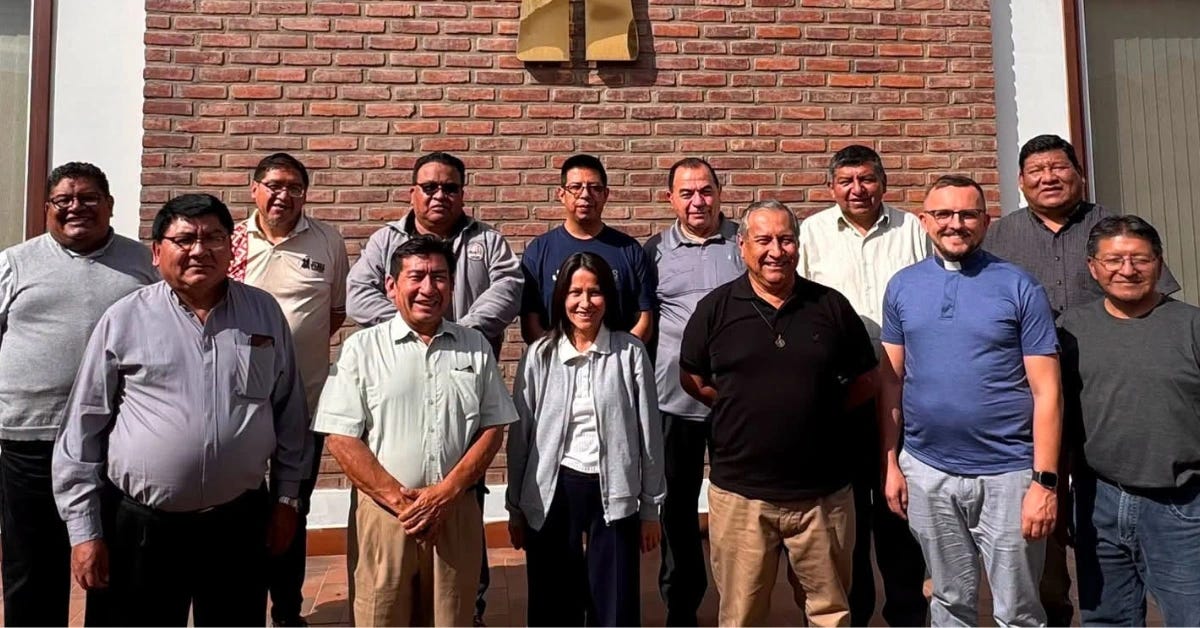
The national meeting, held in Cochabamba, brought together representatives from the ecclesiastical jurisdictions to analyze the reality of the country, present the pastoral lines for youth and families, and reflect on a Church that is closer, credible, and synodal, Micaela Alejandra Díaz Miranda reports for ADN CELAM.
Representatives from the different ecclesiastical jurisdictions of Bolivia met on 15-16 September in Cochabamba to participate in the National Meeting of Pastoral Vicars, a space for reflection on the ecclesial and social reality of the country and for coordinating pastoral actions in the dioceses.
Approaching the reality of families
The meeting proposed a shared perspective on the main difficulties and experiences faced by ecclesial communities, with special attention to the situation of youth and families. The working methodology followed the pastoral scheme “SEE–JUDGE–ACT”, from which the participants analyzed the reality and sought to guide the responses of the Church.
During the first day, the director of the Jubilee Foundation, Juan Carlos Núñez, presented a diagnosis on the situation of youth and family in Bolivia. His presentation addressed the difficulties many young people face in accessing employment and education, as well as the social and economic dimensions currently affecting family life.
Núñez pointed out that approaching the reality of families also involves considering the conditions of coexistence and the challenges faced by their members. The analysis allowed the vicars to identify situations that challenge both society and the pastoral action of the Church.
Church called to be credible
Another of the moments of the meeting was led by the priest Manuel Hurtado, director of the San Pablo Theology program at the Catholic University of Bolivia, who reflected on the changes the Church is going through in the contemporary world.
The presentation addressed the diversity of experiences and voices that currently characterize the Church, as well as the challenges this scenario poses for local communities. Elements of continuity and change between the papacy of Pope Francis and the directions proposed by Pope Leo XIV were also considered.
One of the topics was the ecclesial credibility, especially in light of situations such as abuses, cover-ups, and lack of testimony. The reflection raised the need for the announcement of the Gospel to be accompanied by a life that is coherent and transparent. “The Church must be credible in the face of different situations: abuses, cover-ups, lack of testimony”, it was said during the intervention, when proposing the question about how to make the Church’s testimony more credible.
Pastoral lines for youth and families
On the second day, Father Diego Plá, deputy secretary general of the Bolivian Episcopal Conference, presented the new pastoral lines for youth and families, developed from the last two assemblies of the bishops.
As he explained, these guidelines aim to accompany the realities, needs, and challenges that families and new generations face in Bolivia from the Church’s evangelizing mission.
The day also included the presentation of Kerigma-CEB, a digital tool for evangelization and interactive catechesis aimed especially at children and youth. The application offers games, songs, and content related to the Word of God, as a resource to support the processes of formation and catechesis through the internet. The implementation of these catechesis is scheduled for January 2027, according to the information provided during the meeting.
Synodality from unity and welcome
At the closure of the meeting, there was reflection on synodality, led by priest Juan Pablo Moreno, vicar of the Archdiocesan Pastoral of Santa Cruz de la Sierra.
During the homily, Father Moreno related synodality to unity, fraternity and welcome, based on Jesus’ priestly prayer in the Gospel of John. “May there always be unity, may there always be fraternity, may none be lost because of us, but may all feel welcomed and integrated”, he expressed.
The priest reminded that Jesus’ public life began by calling his first disciples and forming a community to announce the Word. From this experience, he stated that synodality is a way of living faith in community, with participation, centered on Jesus Christ and close to people.
Father Moreno also encouraged accompanying those who seek guidance, closeness, and a Christian testimony, even if they are not formally part of a community. The final invitation was to walk with the Lord, walk united and support with hope all the People of God.
SOURCE
Pastoral vicars of Bolivia share challenges of the Church and the new generations (ADN CELAM)