

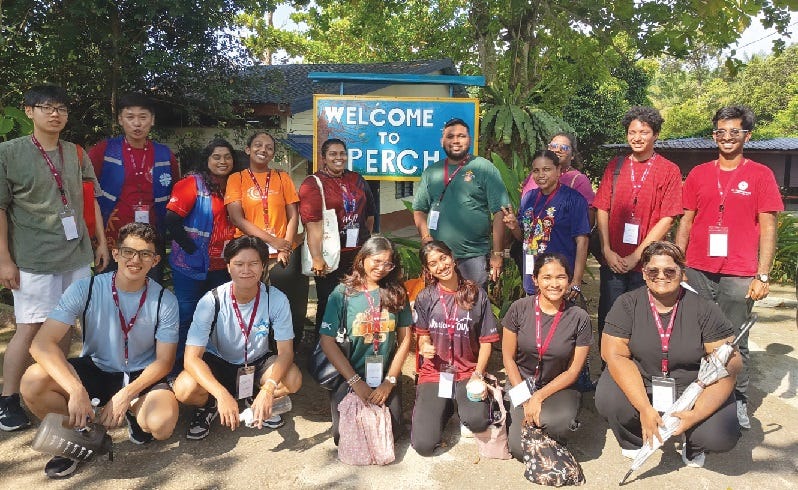
What began as a four-day missionary camp became an invitation for young adults to see people differently — not as refugees, migrants, the sick or the marginalised, but as brothers and sisters bearing the dignity and presence of Christ, Herald Malaysia reports.
Organised by Caritas Penang in collaboration with the Islanders Tamil Youth Network (ITYN), the three-night programme brought young adults to Batu Arang, Gombak, to encounter refugees and people living with HIV/AIDS. Rather than simply exposing participants to unfamiliar realities, the camp taught them to reflect and respond through the See–Judge–Act method.
Using Three Days at Perch, a handbook published by Kumpulan A.C.T.S., Jesuit priest Fr Paul Dass, SJ guided participants through Catholic Social Teaching and the Pastoral Spiral. Gospel meditation, personal prayer and open conversations also helped them connect what they were learning with their own faith and experiences.
On the second day, the participants were divided into three groups. Two visited the St Peter Favre Refugee Convalescence Home (PERCH), while the third served at the Positive Living Community. They carried one question with them: “Where is God leading me in this?”
The question encouraged them to enter each encounter with humility — not merely to help, but to listen, learn and allow themselves to be changed.
Group 1: Love that becomes contagious
The first group visited PERCH’s shelter for men, where refugees who arrived sick, abandoned and without hope receive treatment, care and support during recovery.
Rachel Maria of the Church of the Holy Name of Mary, Permatang Tinggi, was struck by the love shown to complete strangers — people who had experienced persecution and rejection, yet were cared for as members of one human family.
Many residents who had recovered extended a hand to those who arrived after them. For Rachel, their willingness to pass on the care they had received revealed how “contagious” love can become.
The young visitors listened to the men, spoke with them and assisted with simple tasks. Some residents lay in bed but could still smile and laugh. Others grieved their loss of mobility and could see or hear their families only through a mobile phone.
As the young people listened, relationships began to form. They shared tears, prayed with the residents and tried to lift their spirits.
“Our visit was not an ordinary visit,” Rachel reflected. “It became hours of realisation — of stepping outside the world we know and recognising that there are people who need care and love, and who deserve the same dignity as all of us.”
Group 2: Truly seeing the person
At PERCH 2, the second group met women and children who had endured human trafficking, abuse, violence, war, separation and other forms of trauma.
Despite their painful experiences, the residents welcomed the visitors with smiles and hugs. The group helped to prepare lunch and conducted clay art activities with the children. These simple moments allowed them to connect naturally and share a little in the residents’ daily lives.
Among those they met were teenage girls separated from their families. PERCH provided not only shelter and basic necessities, but also education and opportunities to build a future.
Marissa of the Minor Basilica of St Anne, Bukit Mertajam, was especially moved by the residents’ stories of conflict, journeys to Malaysia and separation from parents and siblings. Their suffering reminded her that every person carries a story others may never fully know. Yet their courage and hope remained visible.
The encounter also gave new meaning to See–Judge–Act. To see was not merely to observe from a distance, but to listen and understand another person’s reality. To judge was to reflect on that reality through faith, conscience and Catholic Social Teaching. To act was to respond in a way that allowed faith to become concrete.
“To truly see someone is to recognise their dignity, listen to their story and allow their reality to touch our hearts,” Marissa said. “Only then can our judgement become more compassionate and our actions more meaningful.”
Group 3: The ministry of presence
The third group visited the Positive Living Community, where service began not with the activities they had carefully planned, but with something far more immediate: cleaning the residents’ dusty living and sleeping areas.
As Linda of City Parish, George Town, cleaned, she thought of her own parents growing older. The experience softened her heart and deepened her awareness of the need to care for and respect the elderly.
Afterwards, the group shared a meal with the residents and listened to their stories. Seeing their joy over a special meal was moving, particularly as such meals were usually available only when visitors came.
“It opened my eyes to another side of the world, where people may live in isolation yet continue to live with peace, dignity and grace,” Linda shared. “Even simple acts of service and companionship can make a meaningful difference.”
Brendda of the Church of Our Mother of Perpetual Help, Ipoh, also discovered that God’s plan for the visit differed from theirs. Instead of beginning with organised engagement, the group cleaned, talked with residents and shared lunch.
Those ordinary moments showed her how much the gift of time and presence could mean. When the caretaker, Gabriel, explained that the residents rarely received visitors, Brendda felt called to encourage young people and altar servers in her parish to become involved in similar outreach.
The experience left her with a challenging question: “What would Jesus do?” “If Jesus would never abandon His people, how can we?” she reflected. “Here I am, Lord. Send me.”
Changed by those they came to serve
As the four days drew to a close, the participants realised that the camp was not ultimately about how much they could do for others. It was about learning to be present, to listen, to see and to be changed.
They had arrived intending to serve, but received something greater in return. The people they met carried stories of pain, loss and separation, yet continued to offer smiles, laughter and hope. They showed that hope does not depend upon a perfect life; sometimes it is the courage to rise each day, move forward and believe that life still has meaning.
Through See–Judge–Act, the participants learnt to look beyond labels. Refugees, migrants, the poor and the sick are first and foremost people — each with a story, each created in God’s image, and each deserving to be seen, heard and loved.
They also discovered that mission need not always be dramatic. It may mean sitting beside someone, listening without judgement, sharing a meal, playing with a child, cleaning a room or offering a smile. Such acts may appear small, but they can assure another person that they have not been forgotten.
The participants left Batu Arang with new questions, changed perspectives and a deeper understanding of discipleship. Following Christ, they realised, is not confined to prayer within a church. It also means recognising Him in the people encountered beyond its walls.
“Whatever you did for one of the least of these brothers and sisters of Mine, you did for Me.” — Matthew 25:40
SOURCE
YOUM.A.D 3.0: A missionary experience at Batu Arang (Herald Malaysia)